The Tang Papers investigate how contradictions arise when representational roles are conflated across system description and interpretation, and how these contradictions can be resolved through disciplined separation of scalar, phase, and experiential layers.
In a world where artificial intelligence can produce convincing responses, organizations struggle to stay aligned, and scientific models resist unification, apparent coherence and structural consistency are often mistaken for the same thing.
The Tang Papers extend this diagnostic approach across three layers:
• continuous variation (scalar)
• discrete configuration (phase)
• observer-dependent interpretation (experiential)
Most confusion arises when these layers are not separated.
Independent researcher exploring how representation, coordination, and time organize across complex systems.
My work examines a recurring pattern across science, technology, organizations, and human learning:
Systems often fail not because they lack capability —
but because coordination breaks down as scale, speed, or abstraction increases.
Many contradictions that appear in complex systems arise when different representational roles are confused.
For example:
Scalar descriptions
- quantity
- speed
- accumulation
- measurement
are often applied to phenomena that are fundamentally phase-based, involving:
coordination
- rhythm
- synchronization
- boundary alignment
- structural coherence over time
When this happens, systems may remain technically correct while becoming structurally incoherent or paradoxical.
This diagnostic perspective forms the basis of the Tang Papers research program.
The most recent extension of this work, Relational Coherence Theory (RCT), formalizes the experiential layer — explaining how meaning is interpreted, reconfigured, and persists across time within observer-dependent systems.
Start Here
If you’re new to this work, begin with the question that matches your situation:
• Why does this feel off, even when it looks right?
→ Phase Drift
• How does structure actually form?
→ The Loom
• Why does meaning keep changing over time?
→ Relational Coherence Theory (RCT)
The Tang Papers Research Program
The Tang Papers are an open-access research program exploring how contradictions arise in system descriptions and how they can be clarified through representational discipline.
The program develops a diagnostic framework called:
Phase–Scalar Reconstruction (PSR)
which examines how representational roles are assigned — and where they are incorrectly conflated across scalar, phase, and experiential descriptions
The work spans multiple domains including:
- physics interpretation
- artificial intelligence systems
- organizational coordination
- temporal modeling
- human movement and learning
Formal research papers in the Tang Papers corpus are archived with persistent DOIs.
The framework is not a theory of what systems are, but a method for identifying how they are described, coordinated, and interpreted.
Research Archive
https://www.dancescape.com/research
Zenodo Collection
https://zenodo.org/communities/tang-papers-program
About
Lit Meng (Robert) Tang is an independent researcher based in Burlington, Ontario, Canada.
My work combines perspectives from mathematics, systems thinking, embodied practice, and cross-domain inquiry.
B.Sc. Mathematics — McMaster University
MBA — Schulich School of Business
Before beginning independent research, Robert worked in marketing and communications in the software industry, translating complex technical concepts into public-facing narratives.
He is also a former Canadian & North American Ballroom Champion and co-founder of danceScape, a dance education community where movement is used to develop confidence, coordination, and connection.
Long-term observation of rhythm, anticipation, and coordination in human movement helped shape many of the questions explored in the Tang Papers research program.
Why complex transitions may not have a single date — and why that matters before we try to predict what happens next In my previous article, The Real Question for

It may be how to become harder to constrain — and what the United States risks when leverage becomes pressure For decades, Canadians have been accustomed to thinking about the

When does an alternative become something you can actually use? Canada faces a problem that cannot realistically be solved by becoming bigger. The United States has a much larger economy,

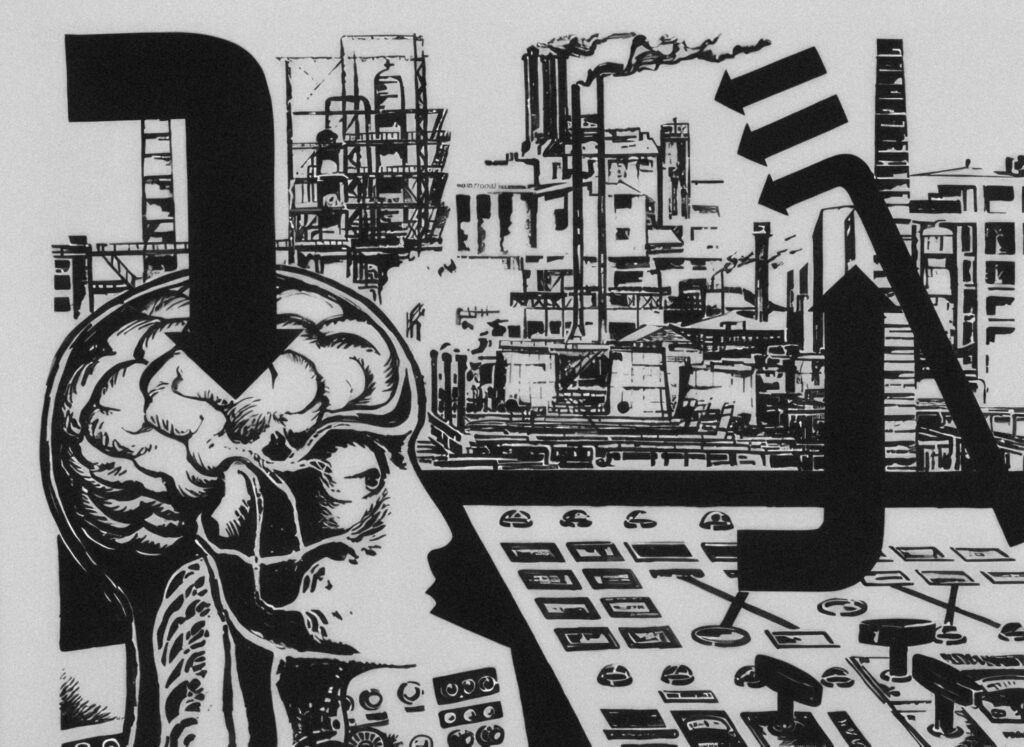
The Factory Series, Paper 4 · Originating Intelligence cannot be prompted. It comes from a life. The Question That Started Everything My father died on October 28, 2025. In the weeks

The Factory Series, Paper 3 · The future belongs to those who architect ideas — not just generate outputs. Here’s how to prove you’re the former. The New Creative Class — Authorship is